Infrared and traditional saunas are different experiences. An infrared sauna warms your body directly with panels at 40–60°C, heats in 15–20 minutes and usually runs from a 13A socket. A traditional Finnish sauna heats the air to 75–95°C, gives soft steam from the stones and needs a dedicated electrical supply.
If you can upgrade your supply, we usually recommend traditional or hybrid. If you cannot, infrared is a very good sauna in its own right.
Key takeaways
- Infrared (Aqua Spazio Radiata): 40–60°C dry heat, no stones, fast heat-up, usually no drainage or supply upgrade. From £9,995 installed.
- Traditional Finnish (Aqua Spazio Sana): 75–95°C at 5–15% humidity, steam from the stones, up to an hour to heat. From £9,995 installed.
- Hybrid gives you both. Aqua Spazio Hybrid hides glass infrared panels on the ceiling of a traditional sauna.
- Evidence differs. Most long-term health research is on traditional Finnish saunas; evidence for infrared is smaller and more limited.
- Prices exclude VAT and builders' preparatory work.

How does each one heat you?
Infrared. Infrared panels emit radiant heat that warms your body rather than the air around you. As Mayo Clinic puts it, an infrared sauna "heats your body directly without warming the air around you." The room stays at 40–60°C, so it feels mild, and you sweat at a lower air temperature than in a traditional sauna. Our infrared saunas use HARVIA infrared panels with touch controls.
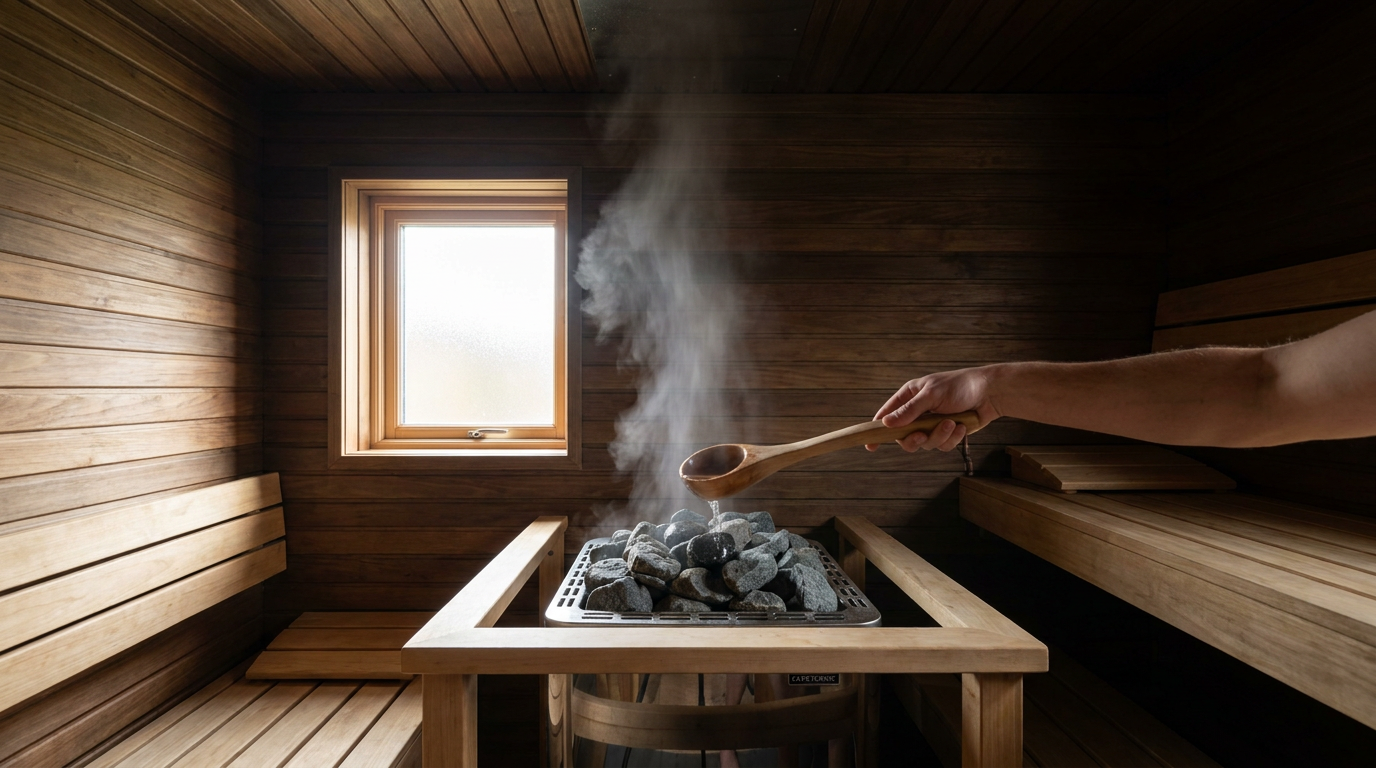
Traditional. A heater warms a mass of stones and the air in the room. The air near the ceiling reaches 75–95°C at 5–15% humidity. When you ladle water onto the stones you get a soft wave of steam and heat. Our standard Finnish saunas use a HARVIA Wall heater with built-in controls; premium builds use freestanding HARVIA or HUUM heaters.

How do they compare side by side?
Feature
Infrared (Aqua Spazio Radiata)
Traditional Finnish (Aqua Spazio Sana)
Air temperature
40–60°C
75–95°C at the ceiling
Humidity
Dry
5–15%, rising briefly with each ladle
Steam from stones
No
Yes
Heat-up time
15–20 minutes
Up to an hour for a typical family sauna
Power
Usually a standard 13A socket
Dedicated supply; 6kW heater typical
Drainage
Not needed
Not essential
Installation
Custom fit in about one week
Typically within five working days on site, after the builder's prep
Price (installed, ex VAT)
From £9,995
From £9,995
Why is power the deciding factor?
In practice, the electrical supply decides more of these choices than personal preference. A traditional heater needs a dedicated circuit sized to its output, which may mean an upgrade from your electrician. Infrared panels usually run from a standard 13A socket with no drainage and no supply upgrade, which is why we recommend infrared when that is all the house can offer. If the supply can be upgraded, we normally recommend a hybrid or traditional sauna.
Which costs more to run?
Infrared heats faster, so it uses less energy before you even sit down. A typical 6kW traditional heater uses about 6kWh to come up to temperature, around £1.80 at 30p/kWh, and roughly £3.00 for an hour's sauna including heat-up.
What does the evidence say?
Most of the long-term research on saunas comes from Finland and concerns traditional saunas. A study of 2,315 middle-aged Finnish men, published in JAMA Internal Medicine in 2015, found that men who used a sauna more often had lower rates of fatal cardiovascular disease and death from all causes over about 21 years. That is an association in one group of men, not proof that saunas cause the benefit, and it says nothing directly about infrared.
For infrared, the evidence base is smaller. A 2009 review in Canadian Family Physician found nine relevant studies and described limited moderate evidence for far-infrared saunas in normalising blood pressure and treating congestive heart failure, weaker evidence for chronic pain, chronic fatigue and obesity, and fair evidence against a role in lowering cholesterol. Mayo Clinic notes that no harmful effects have been reported with infrared saunas but that larger, more exact studies are needed.
So we do not sell either type on health claims. Choose on the experience you prefer and what your house can support. If you have a heart condition, are pregnant or take medication, speak to your GP before using any sauna.
What about a hybrid?
If you want both, a hybrid sauna (Aqua Spazio Hybrid) combines a traditional heater with stones for steam and glass infrared panels mounted on the ceiling, so from inside it looks entirely traditional. A dual control panel runs both. Hybrid saunas cost from £14,995 installed, excluding VAT and builders' work.

What did we build in Virginia Water?
In a Virginia Water basement gym in Surrey, we built a hybrid. The interior is light, knot-free Aspen with a ceiling in contrasting darker tones, floating benches and recessed lighting. Three black infrared panels are mounted on the ceiling above a HUUM HIVE MINI 10.5kW single-phase traditional heater, and a single UKU Glass Wi-Fi controller runs both the heater and the infrared panels.
Basement saunas like this one always need more ventilation planning than outdoor builds, because the room is enclosed by the house.
Frequently asked questions
Is an infrared sauna as good as a traditional sauna?
They are different rather than better or worse. Infrared gives a gentle 40–60°C dry heat with fast warm-up and simple installation; traditional gives hotter air at 75–95°C and steam from the stones. Most long-term health research is on traditional saunas.
Can I run an infrared sauna from a normal plug socket?
Usually, yes. Our infrared saunas (Aqua Spazio Radiata) typically run from a standard 13A socket and need no drainage. A traditional sauna heater needs a dedicated supply installed by an electrician.
Which is cheaper, infrared or traditional?
Infrared is slightly cheaper to run. Our infrared and standard Finnish ranges both start from £9,995 fully installed, excluding VAT and builders' work. Infrared also heats in 15–20 minutes.
Can I have infrared and traditional in one sauna?
Yes. A hybrid sauna combines a traditional stone heater with infrared panels on the ceiling, controlled from one panel. It looks like a traditional sauna inside.
Does an infrared sauna need ventilation?
Yes. Any enclosed room where people sit and breathe needs fresh air in and stale air out, and in a small room exhaled CO2 builds up quickly. We design ventilation for every sauna we build.
Talk to a sauna designer
Not sure which suits your house and supply? Book a free design consultation, or email photographs and dimensions of your space to info@saunacompany.co.uk for an initial assessment. See our infrared sauna range.
Planning one for your own home? See our infrared saunas page for options and recent projects, or book a free design consultation and we'll talk through your space.
Sources
- Mayo Clinic — Do infrared saunas have any health benefits?
- Beever R (2009) — Far-infrared saunas for treatment of cardiovascular risk factors, Canadian Family Physician.
- American College of Cardiology — Is sauna use associated with reduced risk of CV events? (JAMA Internal Medicine, 2015).
Related
- What Makes Good Sauna Steam? Why Steam on Stale Air Isn't a Real Sauna
- How Much Does It Cost to Run a Home Sauna in the UK?
- Home Sauna Comparison: Compare and Choose the Best Home Sauna Types
- Hybrid, Infrared or Outdoor? Choosing the Right Sauna Type for Your UK Home
Planning a sauna of your own? See how our sauna installation service works, from free design consultation to handover.